In The News – 21 hours swimming across Tahoe: New record set
August 3, 2026 | Member Submitted
Originally published in the Tahoe Daily Tribune, 8/3/2026, Written by Petra Molina
Last week, Corey Murphey completed a 20-hour, 54-minute swim from Incline Village to Camp Richardson and back, breaking the previous record, set in 2013, by about an hour. On July 21, the Colorado-based swimmer launched from Incline Village at 8 p.m., swimming through the star-filled Tahoe night and into the next day.
“The moon was so bright that I actually thought my crew was shining a flashlight at me,” Murphey said.
The night seemed to pass quickly, and by the time the sun began to rise, she had already reached Camp Richardson. Under competition rules, Murphey could not spend more than 10 minutes out of the water. She took a nine-minute break to eat a few snacks before beginning the return swim to Incline Village.
The Local Lens: Lake Tahoe Shakespeare Festival Continues to Innovate, Inspire, and Connect
July 29, 2026 | Member Submitted
Guest ‘Local Lens’ Contributor and IVCBA Member: Lake Tahoe Shakespeare
Few organizations demonstrate the power of arts, culture, and community connection quite like the Lake Tahoe Shakespeare Festival. While audiences flock to Sand Harbor each summer for world-class performances, the Festival’s impact extends far beyond the stage, fostering accessibility, innovation, and partnerships that strengthen the broader community.
Now in its 54th Season, the Lake Tahoe Shakespeare Festival has once again captivated audiences with its Mainstage productions of Macbeth and The Heart of Robin Hood. In a recent Reno News & Review feature, reviewer Jessica Santina described the production of Macbeth as a masterful achievement, praising its immersive atmosphere, striking visual design, and exceptional performances. She noted how the production transforms the natural beauty of Tahoe into part of the storytelling experience, transporting audiences from a peaceful summer evening to Shakespeare’s dark and foreboding Scotland. Our Producing Artistic Director, Sara Bruner, and her team have crafted a theatrical experience where every element, from lighting and music to costume and set design, contributes to the emotional intensity of the story. Don’t miss this year’s amazing performances and buy your tickets here or by calling our Box Office Sun-Sat 8:00am-5:00pm at 775-832-1616.
Photo Caption and credit: Macbeth(actor, Jeffery C. Hawkins) and Lady Macbeth(actor, Cassandra Bissell) reunite in the Lake Tahoe Shakespeare Festival production of Macbeth at Sand Harbor, running through August 23rd (Photo by Strotz Photography)
Building Community Beyond the Stage
The Lake Tahoe Shakespeare Festival’s commitment to community engagement is equally evident in our newest partnerships with Liberty Dogs and Keep Tahoe Blue. This season we created opportunities for service dogs in training and their handlers to attend performances, providing critical real-world exposure while supporting the development of future service animals. The partnership highlights our dedication to accessibility and inclusion while creating opportunities to raise awareness for an organization like Liberty Dogs, making a meaningful difference in people’s lives.
We love our venue located at Sand Harbor in Lake Tahoe Nevada State Park and saw an opportunity to help be stewards of the lake. For the first time, the Lake Tahoe Shakespeare Festival has partnered with Keep Tahoe Blue to create our own Tahoe Blue Crew: Keep Shakespeare Blue. If you are already a volunteer with us, be sure to join our Tahoe Blue Crew. On July 5th, we had nine dedicated volunteers join us for our first Keep Shakespeare Blue clean-up and collected 70lbs of trash! Tahoe Blue Crew volunteer shifts are available on Sundays & Thursdays at our venue from 5pm-7:30pm. We have another major clean-up on Aug 13 from 9am-11am. Learn more about Volunteering with the Lake Tahoe Shakespeare Festival here.
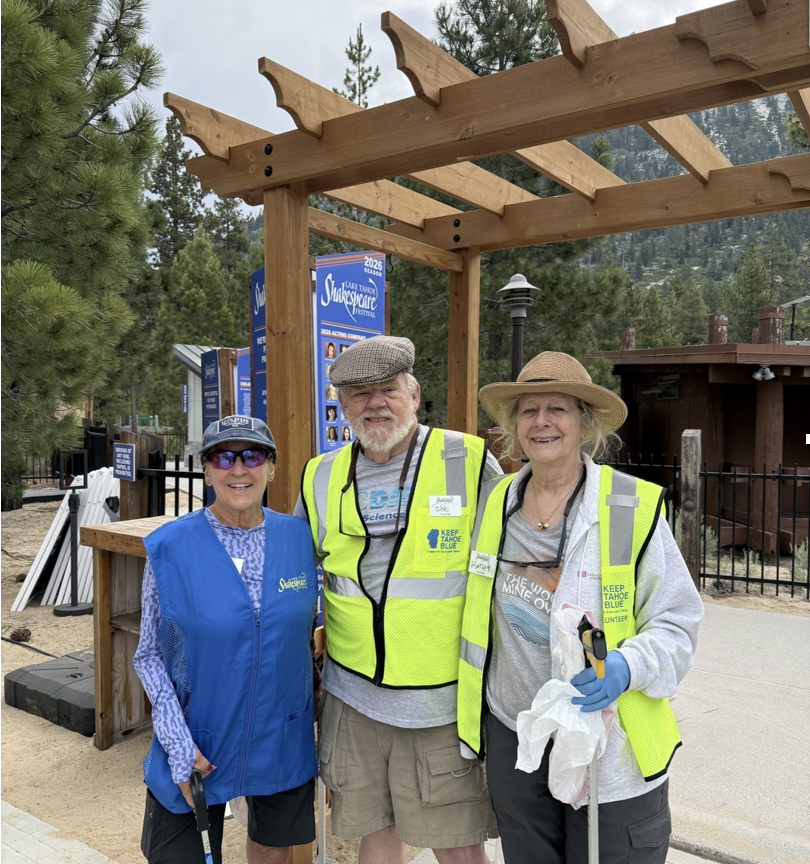
Photo Caption: Keep Shakespeare Blue Clean-up on July 5th with our volunteers L to R: Barbara Stonich, Bob Southern, Kathy Southern
Young Shakespeare Performances July 20-Aug 3 and Final Family Night Aug. 9thThe Heart of Robin Hood
The D.G. Menchetti Education Programs, InterACT and Young Shakespeare, allow us to bring Shakespeare and the performing arts to the youth of our region year-round. InterACT, goes into schools every year and creates a unique curriculum with teachers for students K-12. Every summer, our Young Shakespeare workshop creates an interactive youth adaptation of our Mainstage Shakespeare play with a mix of professional paid actors and school-age performers. This year, you can catch an hour-long, family-friendly, and FREE performance of Macbeth at a local library or partner location near you. Get Showtimes and more information here.
If you missed our first two Family Nights, fret not! We have our final Family Night on Aug. 9 for The Heart of Robin Hood. We will be inviting the young and young at heart to face painting, Robin Hood hat making, and other kid-friendly activities before the show. The fun starts at 6pm on Sunday, Aug. 9. The evening’s activities are hosted by our Platinum Sponsor, Tahoe Expedition Academy, who will also have representatives present and information available about their curriculum and programs for students K-12.
A Lasting Impact
Whether through our critically acclaimed productions, community partnerships, or education programs that reimagine how Shakespeare is experienced, the Lake Tahoe Shakespeare Festival continues to demonstrate the important role arts organizations play in building vibrant communities. If you would like to partner with the Lake Tahoe Shakespeare Festival, please reach out to our Community Engagement Manager, Jessica Vela, at Jessica@LakeTahoeShakespeare.com
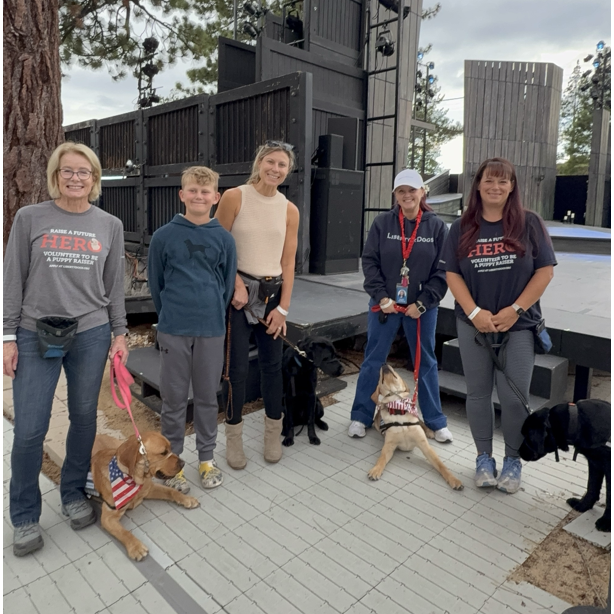
Photo Caption: Patty Jansen, Lake Tahoe Shakespeare Festival Board Chair, Jenny Molinelli and son, Jasper, Puppy Outreach Coordinator for Liberty Dogs, Kaci Janson and all their incredible Service Dogs in Training at the July 21st performance of Macbeth.
Great Futures Productions Presents The 25th Annual Putnam County Spelling Bee
July 28, 2026 | Member Submitted
Tony and Drama Desk Award-winning musical comedy comes to the Boys & Girls Club of North Lake Tahoe
The Boys & Girls Club of North Lake Tahoe’s Great Futures Productions is thrilled to present The 25th Annual Putnam County Spelling Bee, a hilarious musical about friendship, competition, and the power of words, running July 31 – August 2nd, 2026, at the Boys & Girls Club of North Lake Tahoe Clubhouse in Kings Beach.
Winner of the Tony Award and Drama Desk Award for Best Book, The 25th Annual Putnam County Spelling Bee has charmed audiences across the country with its effortless wit and humor. Featuring a fast-paced, wildly funny, and touching book by Rachel Sheinkin and a truly fresh and vibrant score by William Finn, this bee is one unforgettable experience.
An eclectic group of six mid-pubescents vie for the spelling championship of a lifetime. While candidly disclosing hilarious and touching stories from their home lives, the tweens spell their way through a series of (potentially made-up) words, hoping never to hear the soul-crushing, pout-inducing, life-un-affirming “ding” of the bell that signals a spelling mistake. Six spellers enter; one speller leaves a champion! At least the losers get a juice box. The show is a riotous ride that includes audience participation. Four audience members, who can apply to be guest spellers starting 45 minutes before each show, will get selected to join the live performance. The 25th Annual Putnam County Spelling Bee is a delightful den of comedic genius.
Great Futures Productions is the Children’s Theatre Company of the Boys & Girls Club of North Lake Tahoe. Great Futures Productions creates extraordinary theatre experiences that educate, challenge, and inspire young people and their communities, unleashing the power of curiosity, empathy, and imagination. The program is dedicated to enriching the lives of young people by offering opportunities in the performing arts that engender self-confidence, inspire both individual expression and ensemble teamwork, and provide positive role modeling, thereby encouraging community outreach through quality theatrical productions for children and teens. Each year, Great Futures Productions produces five musicals and one play, including one musical produced in partnership with Incline High School, along with year-round classes in singing, dancing, and acting.
“I chose The 25th Annual Putnam County Spelling Bee because it’s one of those rare shows that lets young performers be genuinely, hilariously themselves on stage,” said Sara Turner Carbajal, Director of Great Futures Productions & Performing Arts at the Boys & Girls Club of North Lake Tahoe. “Every character in this show is a little awkward, a little brilliant, and completely lovable, and that’s exactly the message we want our kids to walk away with: that the things that make you different are often the things that make you shine. It’s also just an incredibly fun show, for our performers and for our audiences, and after the year our cast has put in, they deserve a production that lets them be funny, be vulnerable, and take a real bow.”
Performances of The 25th Annual Putnam County Spelling Bee will take place Friday, July 31 at 7:00 PM, Saturday, August 1 at 2:00 PM, Saturday, August 1 at 7:00 PM, and Sunday, August 2 at 7:00 PM at the BGCNLT Clubhouse in Kings Beach at 8125 Steelhead Ave. Tickets are available at bgcnlt.org.
About Great Futures Productions Great Futures Productions is the Children’s Theatre Company of the Boys & Girls Club of North Lake Tahoe, dedicated to enriching the lives of young people through quality theatrical productions, classes, and community outreach in the performing arts.
About the Boys & Girls Club of North Lake Tahoe The Boys & Girls Club of North Lake Tahoe provides safe, structured, and enriching programming for youth ages 2–18 in Kings Beach, Tahoe City, Truckee, and Incline Village. The Club serves more than 1,700 youth or 1 in 4 local families. The Boys & Girls Club of North Lake Tahoe’s mission is to inspire and enable all youth, especially those who need us most, to reach their full potential as productive, caring, responsible community members.
Media Contact Siobhan Brady Director of Donor & Community Engagement Boys & Girls Club of North Lake Tahoe sbrady@bgcnlt.org
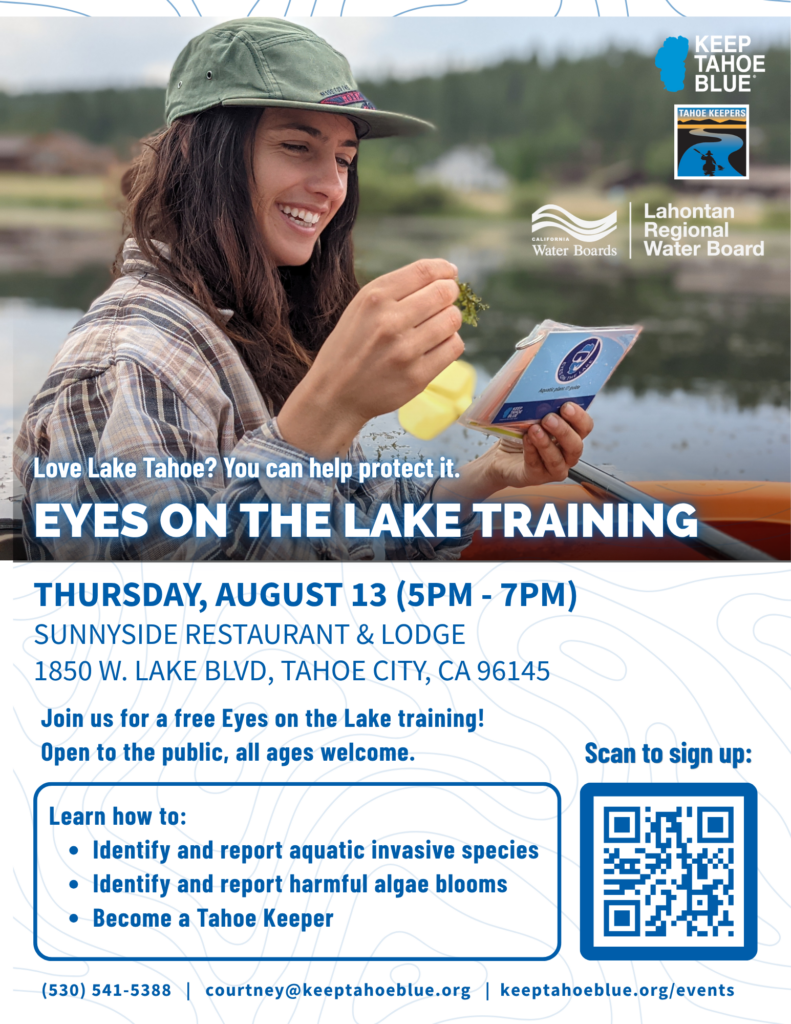
Do you love to kayak, paddleboard, and walk on the shoreline at Lake Tahoe? Then join us for a free Eyes on the Lake training! This training is open to the public, all ages welcome.
Learn how to identify Tahoe’s various native and invasive aquatic plants, and how to report observations that allow Keep Tahoe Blue and our partners to control new populations of aquatic invaders before they do lasting damage to Lake Tahoe. We want to be sure that Lake Tahoe remains clear and blue!
Our friends from Tahoe Keepers and the Lahontan Regional Water Quality Control Board will be joining this training and sharing tips on how to clean, drain, and dry your equipment and how to identify potential harmful algae blooms (HABs).
Be sure to bring: Your phone to submit an Eyes on the Lake Citizen Science Tahoe survey, hat, sunscreen, sunglasses, wear shorts and shoes that might get wet while surveying at the shoreline.
We provide: Training, a waterproof ID guide, pencils and paper for notes, and refreshments
In The News – Meet the Tahoe-made Valkyrie, a women’s ski designed for the fierce
July 28, 2026 | Member Submitted
Originally published in the Sierra Sun, 07/28/2026, Written by Katelyn Welsh
What started as an observation on a chairlift turned into the development of a women’s ski designed to hold up to the strength and speed with which hard-charging female skiers attack the mountain.
“When we go to ski out there,” She-Shredz founder Constance Traynor said, “sometimes it feels like you might be going to war a little bit, and when you go into battle, you want something that’s going to keep up with you and that you can trust.”
Meet the Valkyrie, a collaboration of She-Shredz, a Truckee-based and global-reaching online platform for all things women’s ski and snowboard, and Praxis Ski, a factory handcrafting skis out of Incline Village.
In The News – USDA announces $50 million investment to expand timber production, enhance forest health in Nevada
July 28, 2026 | Member Submitted
Originally published in the Tahoe Daily Tribune, 7/27/2026, Staff Report
U.S. Department of Agriculture Rural Development Nevada State Director Alida Ceballos today announced that Tahoe Forest Products, LLC. will receive $50 million to expand timber processing capabilities at its business in Carson City. This significant investment comes through a partnership between the USDA and MapleMark Bank and will enable the business to access guaranteed loan funds to support domestic timber production.
Ceballos said, “Thanks to the leadership of Secretary of Agriculture Brooke Rollins and President Trump, USDA is partnering with lending institutions to make this substantial investment in new and upgraded timber processing equipment for Tahoe Forest Products, LLC. This investment supports sustainable timber harvesting that improves forest health, reduces wildfire risk, and strengthens rural prosperity by creating jobs for hardworking Americans. Nevada is proud to further the Trump-Vance investments into our great state.”
Lake Tahoe’s best summer days are worth protecting. A beach day, trail walk, paddle, or dog-friendly outing all depend on clean beaches, healthy forests, clear water, and shared respect for the places we all love. Those conditions are shaped by the small choices made before and during your time exploring Tahoe.
Bring reusables instead of single-use plastics
Use lake-friendly transportation when you can
Clean, Drain, Dry gear before it touches the water
Clean up after your pet so Tahoe’s dog-friendly areas stay clean, open, and welcoming.
Pick it up, pack it out, and toss it in the trash
This month’s Spotlight highlights the everyday choices and dedicated people who help Tahoe stay enjoyable, safe, and protected. From wildfire awareness and aquatic invasive species prevention to the volunteers, Tahoe Blue Crews, and interns working behind the scenes, these efforts are making a difference. Meet the stewards and discover the small actions that add up to a better Tahoe for everyone.
Growing to Meet the Community’s Mental Health Needs
July 28, 2026 | Member Submitted
For many years, the Tahoe Family Solutions (TFS) mental health team has worked within limited office space, making it difficult to keep pace with the growing need for counseling services in the North Lake Tahoe community.
That changed this month when we moved our entire mental health program into a dedicated counseling center less than a mile from our main office on Incline Way. The new location features a welcoming reception area, private offices for every clinician, and a dedicated play therapy room designed specifically for children.
Tahoe Family Solutions was founded in 1991 with the primary goal of providing mental health services to the community. As additional needs emerged, we expanded our programs to support children, families, and individuals in new ways while remaining committed to that mission. Today, we serve approximately 200 mental health clients each year, and demand for counseling and related services continues to grow.
The expanded facility is more than a new address. It’s part of our ongoing commitment to making quality mental health care more accessible, comfortable, and effective for everyone who walks through our doors.
Creating a Safe, Consistent Space for Healing
One of the biggest benefits of the new office is consistency.
Previously, therapists often had to share space, which meant clients might meet in a different office from one appointment to the next. Now, each therapist has a dedicated office where clients know exactly where they’ll be every visit.
Katie O’Hara, MA, LCPC, who serves as a mental health therapist and clinical manager for Tahoe Family Solutions, while maintaining her private practice, works with adults, couples, teens, and children. She believes the new location will create a more welcoming, consistent experience for both clients and clinicians.
“This way everyone gets their own space and our clients know where they’ll be every time,” O’Hara said. “There’s something about consistency that I think makes clients feel safe. They’ll be able to look forward to being in the same room every time they meet with their therapist.”
Each office has been designed to feel warm and welcoming, with comfortable furniture, sensory tools, and personal touches.
“Even something as small as having a couch and little fidgets can make a difference,” she said.
The new play therapy room gives younger children a dedicated space where they can process emotions and experiences through play in a developmentally appropriate setting.
Expanding Access to Care
Getting care isn’t always as simple as making an appointment. Transportation, cost, language, and availability can all stand in the way. The new counseling center helps remove many of those barriers.
Located on the public bus route, the office is easier to reach for clients without reliable transportation. Counseling services remain free, ensuring finances are never a barrier to receiving care.
The expanded space will ultimately allow us to increase appointment availability and reduce wait times.
“With the additional money we’re able to get from grants and private donations, we’ll be able to add more hours for our therapists,” O’Hara said.
Language access is another important part of expanding care. The team includes three Spanish-speaking clinicians, allowing many bilingual and bicultural clients to receive services in the language they’re most comfortable using.
“There are just as many Spanish speakers as there are English speakers on the waitlist, so having bilingual therapists providing their services has been incredible,” O’Hara said.
While Tahoe Family Solutions has provided interpreters when needed, she says speaking directly with someone who understands both their language and culture creates a different experience.
“It’s an unmatched experience being able to sit across from someone who you share a similar cultural background with,” she said.
The expanded services have been made possible through generous community support, including funds raised through Shabby Chic, grant funding, and donor contributions.
Comprehensive Mental Health Services
Working with a team of professionals, TFS offers mental health care for children, adolescents, and adults through a range of services, including:
Child, Adolescent and Family Counseling
Parent and Child Interactions
Healthy Family Relationships
Success in School
Play Therapy
Conflict Resolution
School Adjustment
We also provide psychiatric care through licensed psychiatric provider Dr. Sukhi Johal, who works with children, teens, and adults to evaluate symptoms, diagnose mental health conditions, and develop individualized treatment plans.
Psychiatric services include:
Comprehensive psychiatric evaluations
Medication management for anxiety, depression, ADHD, mood disorders, and more
Ongoing support and check-ins to ensure treatment is working
Collaboration with our in-house therapy team for integrated care
The Importance of Mental Health
Although awareness of mental health has improved in recent years, O’Hara believes there is still work to do.
“If someone has a broken bone, they’ll go to the doctor,” she said. “But if someone is going through a broken heart, they’re more likely to think, ‘I’ve got this. I can handle this.’”
She encourages people to think of therapy as routine care rather than a last resort.
“I think going to therapy is kind of like going to the dentist, but for your brain,” she said. “Our mental health is everything. It’s how we interact with the world. It’s how we perceive things. It’s how we form connections, or sometimes struggle to form connections. Our mental health is at the forefront of everything, and it’s just as important as our physical and spiritual health.”
We hope the new counseling center will help even more individuals and families find the support, healing, and hope they need.
Mental health services are currently provided free of charge through Tahoe Family Solutions, although donations are always appreciated. Community support helps us continue expanding access to quality mental health care for everyone who needs it.
Contractors Association Of Truckee Tahoe Debuts New Digital Hub
July 28, 2026 | Member Submitted
“CATT Bid Connect” will help local homeowners find professional contractors
The Contractors Association of Truckee Tahoe (CATT) is expanding and modernizing its bid request program with the launch of CATT Bid Connect, a new digital platform designed to help local property owners find the right CATT professional for any project, regardless of size or budget.
The platform gives homeowners and property owners a simple front door into CATT’s network of more than 400 qualified local building professionals. Whether the need is landscaping, repairs, a specialty trade, a remodel, or a larger high-end residential construction or commercial project, property owners can submit a single request and let CATT point them in the right direction.
“CATT has always helped connect our community with qualified local building professionals,” says Denise Van Beek, CATT membership manager. “This new platform expands that capability by giving property owners one simple place to start, whether they have a small property need or a major construction project. It also helps our members receive more relevant opportunities based on the type of work they actually do.”
How It Works
The process is easy. Property owners can request a bid online, by phone, or by texting BID to CATT at (530) 536-1115. They simply provide details on the job they need done and their request is organized by project type, trade category, location, and scope, and then routed to the CATT members who actually perform that kind of work.
“Our goal is to make CATT the easiest and most trusted starting point for local property owners who need help with a project,” says Van Beek. “This platform helps us quickly connect requests with our trusted list of local professionals, so it takes the guesswork out of finding a contractor.”
Another benefit of the new platform is that it expands the variety of projects for which property owners can submit requests. A traditional bid request form can feel like it is only meant for larger, serious construction jobs. CATT Bid Connect broadens that idea. The platform can take in a wide array from requests, from small, quick fixes, to larger and more complex long-term jobs.
Examples include:
Handyman jobs
Defensible space
Tree work
Landscaping
Repairs and maintenance
Decks and exterior improvements
Roofing, windows, doors, and specialty trades
Remodels and additions
High-end residential construction
Commercial tenant improvements
Larger commercial or custom construction projects
The platform is powered by Bedrok Labs, a local technology company founded by Bevan Waite that builds intelligent communication and intake tools for contractors and construction organizations.
About CATT
The Contractors Association of Truckee Tahoe is a regional trade association dedicated to promoting a positive business environment for the building and housing industry. CATT connects property owners with hundreds of qualified and reliable member businesses for remodeling and new construction projects throughout the Truckee-Tahoe region, while providing its members with advocacy, education, networking, and business resources. Learn more at ca-tt.com.
In The News – Incline Village REALTORS® leverages Fair Housing Grant to advance education, training
July 28, 2026 | Member Submitted
Originally published in the Tahoe Daily Tribune, 7/28/2026, Staff Report
The association of Incline Village REALTORS® (IVR) received a $3,000 Fair Housing Grant to support national speaker Nate Johnson Overcoming Barriers to Fair Housing, at the Chateau in Incline Village Lake Tahoe, reinforcing its commitment to fair housing education, professional responsibility and housing access.
The grant award is made possible by the National Association of REALTORS® as part of its Community Development Advocacy program empowering REALTOR® associations to strengthen their communities through effective advocacy, partnerships, and on-the-ground initiatives.
“Nate engaged with all of us in a space of openness, safety & genuine inquisitiveness. The training was informative and interesting… I really appreciated the way Nate encouraged discussion and made everyone feel comfortable participating,” said Heather Bacon, Compass Real Estate Advisor.