Published by TRPA
With the recent wildfires in Los Angeles, California (2025) and Davis Fire just west of Reno (2024), wildfire is becoming a more pressing issue for many urban areas that traditionally have not faced this threat. Tahoe’s history and current priorities for forest health and wildfire offer insight into successful actions that can reduce wildfire risk and ensure communities are prepared for wildfire.
ABBREVIATED HISTORY OF FOREST MANAGEMENT AND WILDFIRE AT TAHOE
10,000 years ago The Washoe Tribe of Nevada and California are the original inhabitants of the Tahoe Basin. For more than 10,000 years the Washoe Tribe were stewards of Lake Tahoe and the surrounding environment. Fire played an important role in this stewardship. The Washoe Tribe would perform cultural burns in the forests to reduce overgrowth and promote growth of food and medicinal plants during the next spring. Today, the Washoe Tribe is returning cultural fire to the Tahoe landscape.
1844 – 1890
American explorer John C. Fremont arrived in Tahoe in 1844. From 1860 to 1890, an estimated two-thirds of the Tahoe Basin was clear cut to supply timber for the mines in Virginia City during the Comstock mining era.
1890 – 1960
Following this era of destruction, the forests around Tahoe grew back in an unnatural manner with high tree density and lack of species diversity. At the same time, the federal government adopted a policy of total fire suppression. The combination of fire suppression and unnatural secondary forest growth resulted in high levels of threat from wildfires.
2002
The Gondola Fire burned 600 acres of forest in South Lake Tahoe. Fortunately, there was no property damage. The fire raised awareness among Tahoe agencies and the public about the growing threat of fire.
2004
In response to the Gondola Fire, Tahoe Basin partners adopted the first-ever Community Wildfire Protection Plan for Lake Tahoe. The goal of the plan was to strategically address wildfire risk and create healthy forests.
2007
The Angora Fire burned 3,100 acres and destroyed 254 homes and structures in South Lake Tahoe. This is the most destructive fire in Tahoe’s modern history and was once again a call to action for the Tahoe Basin to address wildfire risk. Following the Angora Fire, Nevada and California created the California-Nevada Tahoe Basin Fire Commission. This commission was tasked with completing a review of the laws, policies, and practices that affect the vulnerability of the Tahoe Basin to wildfires. The Commission’s final report included 48 findings and 90 recommendations organized into six categories that addressed environmental protection, issues of governance, community and homeowner fire prevention, forest and fuels management, fire suppression, and funding.
2017
A report evaluating progress on implementing the Commission’s recommendations found that at the time 59 percent of the recommendations were complete or ongoing, 25 percent partially complete, 7 percent initiated, and 9 percent not started or deemed infeasible.
2021
The Caldor Fire tested the decades of work at Tahoe since the Angora Fire. The Caldor Fire burned into the southern end of the Tahoe Basin, burning roughly 10,000 acres inside the Basin boundary. While the fire destroyed the community of Grizzly Flats to the West of Tahoe, there were no residential homes lost in the Tahoe Basin. The success of fighting the fire is attributed to many factors including forest fuel reduction projects in the area, availability of water to fight the fire, homeowner defensible space measures, favorable wind and weather patterns, and a large firefighting force.
2024
Tahoe Basin public safety agencies released a new basin-wide evacuation plan for the public. This plan was developed by the cooperative efforts of the Lake Tahoe fire chiefs and law enforcement agencies following the Caldor Fire. The plan is intended to provide the public with critical information related to evacuations and is considered a living document that will be updated on an ongoing basis. Tahoe agencies presented about forest health, wildfire, and evacuation planning at the June 7, 2024 meeting of the Interim Oversight Committee for the TRPA and Marlette Lake Water System.
2025
The Tahoe Fires and Fuels Team released an updated Community Wildfire Protection Plan (CWPP) for the Tahoe Basin. The updated plan addresses the region’s evolving wildfire risks, focusing on fuels reduction, preparedness, structural ignitability, and wildfire response.
TAHOE FIRE AND FUELS TEAM
Born out of the Angora Fire in 2007, 21 Tahoe agencies formed the Tahoe Fire and Fuels Team (TFFT) to enhance collaboration around wildfire risk reduction. Since its formation, partners have treated more than 75,000 acres of hazardous fuels and engaged more than 90 certified Fire Adapted Communities in wildfire prevention actions. In 2019, the TFFT released the Forest Action Plan. This document is the Region’s roadmap for achieving comprehensive wildfire risk reduction.
ADDITIONAL WILDFIRE ACTIONS AND BEST PRACTICES
The following is a summary of actions and best practices implemented in the Tahoe Basin to support healthy forests, reduce wildfire risk, and ensure community preparedness.
Vegetation Management
• The 2019 Forest Action Plan identified 22,000 acres of treatments remaining to complete all Basin initial entry wildland-urban interface (WUI) treatments. By the end of 2024, partners had completed approximately 18,000 acres of initial entry WUI treatments. This puts completion of the identified goal of 22,000 acres in the summer of 2025.
• Community Wildfire Protection Plans (CWPP) have become one of the most important wildfire mitigation plans for communities. Many funders of fuel reduction projects have requirements that link back to the need for a CWPP. The Basin completed the first CWPP in 2004 with updates in 2015 and 2025. The 2025 CWPP is crucial for planning the next five years of work and positioning Lake Tahoe for continued funding.
• Policy changes to TRPA’s Code of Ordinances in 2023 allow mechanical treatment on steeper sloped land while maintaining water quality standards. These changes allow more acres to be treated with more efficient equipment allowing public investment to get more work completed. Infrastructure • Basin partners recognized water for fire suppression was an issue during the 2007 Angora Fire. Since 2009, water purveyors on both sides of the Basin have leveraged $20 million in federal funding to install $52 million worth of improvements to their water delivery systems, specifically to address firefighting needs.
• Powerlines are a vital part of the Basin’s infrastructure but are also a major potential source of wildfire ignitions. Through the Powerline Resilience Corridor strategy, utility companies are removing hazards near utility lines and undergrounding transmission lines where feasible.
New and Emerging Technologies
• Fire Aside – a new Defensible Space software program is designed to be more user friendly for implementors and the public. It collects additional data that can be used to model wildfire risk using on-the-ground real time inputs. Partners are working to use this new modeling information to show community-based risk reduction to the insurance industry.
• Land Tender – new decision support tool for land managers uses LiDAR and satellite data to prioritize fuel hazard reduction treatments to provide the greatest returns.
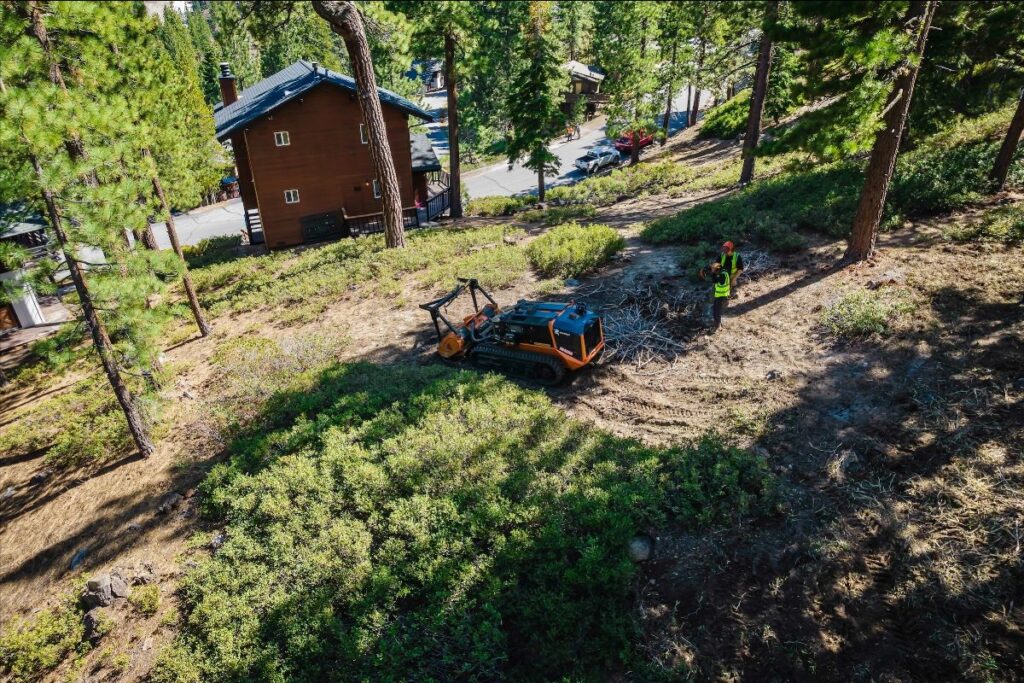
• BurnBot – Tahoe partners attended a presentation of the BurnBot in 2024. BurnBot is a new, innovative tool created to help increase the pace and scale of forest restoration. The $50,000 pilot project masicated 75 percent of the vegetation on 22 acres in three days. This would have taken one hand crew or 20 firefighters 15 days to complete.
• AlertWildfire Cameras – First launched in Lake Tahoe, the AlertWildfire camera program has installed more than 1,000 cameras across six states to provide real-time video monitoring of forests for early detection of wildfire starts.
Capacity building
• Tribal capacity – Tahoe partners have funded staff with the Washoe Tribe of Nevada and California to increase Tribal capacity and presence in the Basin as well as to partners for Tribal led projects at Mayla Wata (Meeks Meadow). The Washoe Tribe also hosted their first ever TREX training which certified crews to complete this type of work.
• Local Fire Departments – Increase staffing and capacity to manage fuel hazard reduction projects on private and local government property as well as to promote Fire Adapted Community education.
• Fire Adapted Communities – The Tahoe Resource Conservation District manages the Basin’s Fire Adapted Communities Program. This program works closely with local fire departments for education, defensible space inspections, community workdays, etc. Transportation and Evacuation Planning
• The transportation system plays a critical role in supporting emergency response and evacuation during wildfire. During the Caldor Fire the entire south shore community evacuated in four hours. Early communication, planning, and engagement with the public were key to the success of this evacuation.
• In 2024, TRPA was awarded a $1.7 million federal PROTECT Grant to help Lake Tahoe law enforcement, fire, and emergency management agencies create plans for resilient transportation infrastructure and emergency communications. The project will deliver plans to harden and improve roadway infrastructure to wildfire and extreme weather events, and improve emergency communications.
Tahoe continues to build resilience for wildfires and treat more acres of forest to reduce wildfire risk. However, we know that it isn’t a matter of if, but when the next wildfire happens. Our goal is to be well prepared.